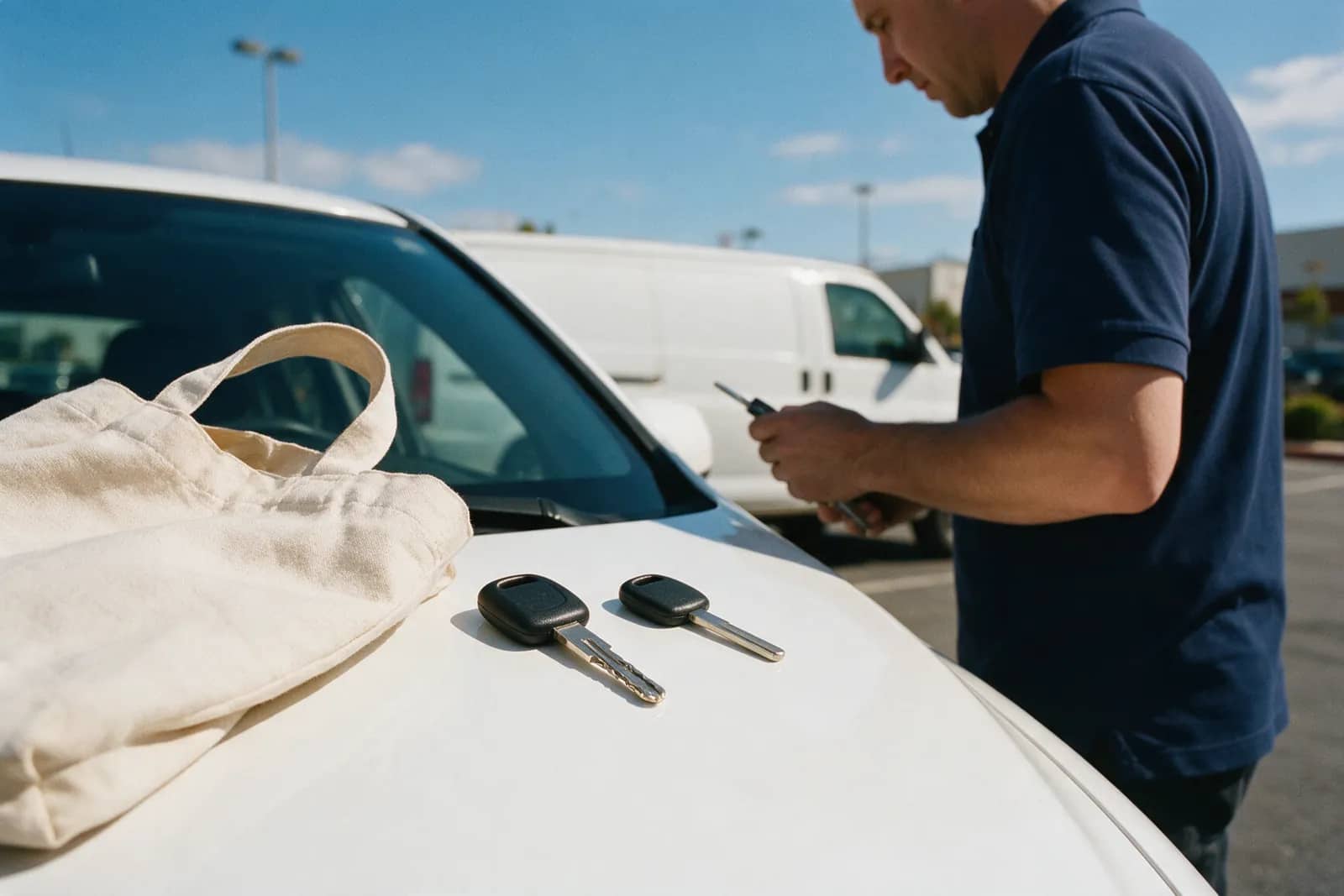
What a proximity fob actually does
A passive-entry fob is a small radio. When you touch the door handle, the car sends a low-frequency pulse a metre or two around the handle; the fob hears it, wakes up, and replies on a higher frequency with a rolling code the car checks against its own. If the reply is right the door unlocks, and a second exchange inside the cabin lets the start button work. The metal key blade tucked inside the fob and the covered keyhole on the driver's door exist for the day one side of that conversation goes quiet.
Phone keys and NFC cards are the same idea with a different radio. A card held to the pillar is read at a few centimetres; a phone is authorized over Bluetooth or ultra-wideband and then behaves like a fob. All of them depend on the car having enough power to run the conversation, which is where the next section comes from.
The EV that ignores its fob is usually a battery
An electric car has a large traction battery and a small 12-volt battery, and the second is the one that runs the door locks, the body computer and the receiver that listens for the fob. When the 12-volt is flat, the car is silent: the handle does not respond, the card does nothing, the screen is dark. Owners in the garages under Santa Clara Square and Rivermark call this a lockout or a dead fob, and about half the time it is neither. The fob is fine. The car cannot hear it.
That is worked out on the call: if the fob battery is recent and the car shows no life at all, the first step at the curb is finding the 12-volt and putting power on it, after which the fob works and the door opens. Where the car can be opened mechanically first, the hidden keyhole under the handle cover or a release behind a tow-eye cap is used. Once the door is open, the 12-volt is charged or replaced and the rest of the visit is unnecessary. The figure agreed on the call for a lockout, $95 to $179, is the ceiling for that.
Which cars can be programmed at the curb
Most mainstream makes, the Japanese, Korean and American brands and most German ones, allow a new fob to be paired at the vehicle through the diagnostic port with the right tool and an ownership check. Fob programming is $96 to $179 and takes twenty minutes to an hour at the car. A few makers are closed: some EV brands issue cards and phone keys only through the manufacturer app or a service centre, and a locksmith will say that on the call rather than at the curb. The year and model decide it, which is why they are asked for first.
A detail that catches people out: some vehicles require two working keys to be present to add a third without a dealer, and some erase all existing keys when a new one is added, so the spare at home has to be re-paired in the same session. Neither is a problem if it is known before the visit, and both are a problem if it is not. Say how many keys the car has and where they are.
Lost every key: what the visit looks like
When no key exists, the job is a replacement at $139 to $389, and it has three parts. The door is opened, usually through the mechanical keyhole. The immobilizer is accessed, and on cars with a locked security gateway that means a manufacturer authorization step that the technician handles with proof of ownership. A new fob is cut, if it has a blade, and paired, and the old keys are removed from the car so that whoever finds them in a coat next spring has a paperweight. Budget an hour at the car, longer on a make that needs the authorization step.
The ownership check is stricter than for a lockout because the result is a key that starts the car: registration or title and a matching ID, and if the car is a company car or a lease, something showing you may act for the company. It is the same at a house in Central Park and in a garage on Scott Blvd, and it is the reason the process is worth trusting.
Batteries, ranges and the fob left on the kitchen counter
The coin cell in a fob lasts two or three years and dies in a cold garage rather than in a warm driveway. Most cars warn about it on the dashboard for weeks first, and most owners dismiss the warning. Replace the cell on a date you remember, and keep the type written down; several fobs use a cell one size off the common one. A fob whose range has shrunk from a car length to a hand span is telling you the same thing.
Hybrids and plug-ins add one habit worth having: know where the mechanical keyhole is on your car before you need it. It is under a cap on the handle, or behind a small panel at the bumper, and a surprising number of owners have never removed the blade from the fob or found the cap. Two minutes in daylight with the manual saves a call in a garage at eleven at night. Fob programming for a spare, at $96 to $179, is the other daylight task that prevents the evening one.
Garages, levels and getting the van to the car
Santa Clara stores its cars underground and in structures more than most cities its size: under the apartment blocks along Lawrence Expressway, in the campus garages along Tasman Dr, in the Caltrain lot behind the depot. Every one of those needs a description that finds the car: the level, the nearest stair core or column bay, and whether the technician can drive in or must be met at a pedestrian door. Cell reception three levels down is poor; a text with the details, sent from the ramp, arrives when a call does not.
Payment is by card or tap at the car, the itemized receipt reaches your email before the van leaves the level, and calls are answered 24/7. Evening between 8pm and midnight adds $45, overnight adds $80, and both are inside the figure agreed on the call rather than discovered on the receipt.
Quick answers
My EV does not respond to the fob or the card. Is the fob broken?+
Often not. A flat 12-volt battery leaves the car unable to hear any key. The car is opened mechanically or given power at the curb, and if the fob then works the visit ends there, within the $95 to $179 lockout figure agreed on the call.
Can a locksmith program a fob for any car at the curb?+
For most mainstream makes, yes, at $96 to $179 with an ownership check. A few EV makers issue cards and phone keys only through their own app or service centre, and that is said on the call once the year and model are known.
What does a replacement cost if every key is lost?+
$139 to $389 depending on the vehicle, covering the opening, the immobilizer work and a new cut and paired fob, with old keys removed from the car. Registration or title and matching ID are required, and the $89 service call is inside the figure.
Need it handled rather than read about?
(669) 721-9707More guides