What was fitted in 1957
The tracts around Central Park, Bowers Park and Killarney Farms went up in a few years in the mid-1950s, and most got the same hardware: a key-in-knob lockset, brass or bronze, with a spring latch worked by the knob and a small pin cylinder in the outside knob. Turn the key, the knob turns, the latch retracts. There was no deadbolt on the drawing, and on a great many kitchen doors and garage side doors there still is not. The set is bored through the door at a standard height with a 2 3/8 inch backset, the distance from the door edge to the centre of the hole, and that dimension has decided everything fitted to the door since.
It is not bad hardware. Seventy years of turning has worn the plug, the springs have softened and the latch bolt has rounded off, but the mechanism is simple and the brass is thicker than what replaces it. The question on these doors is never whether the knob works. It is whether a spring latch is the only thing on the door.
Why the knob alone is not enough
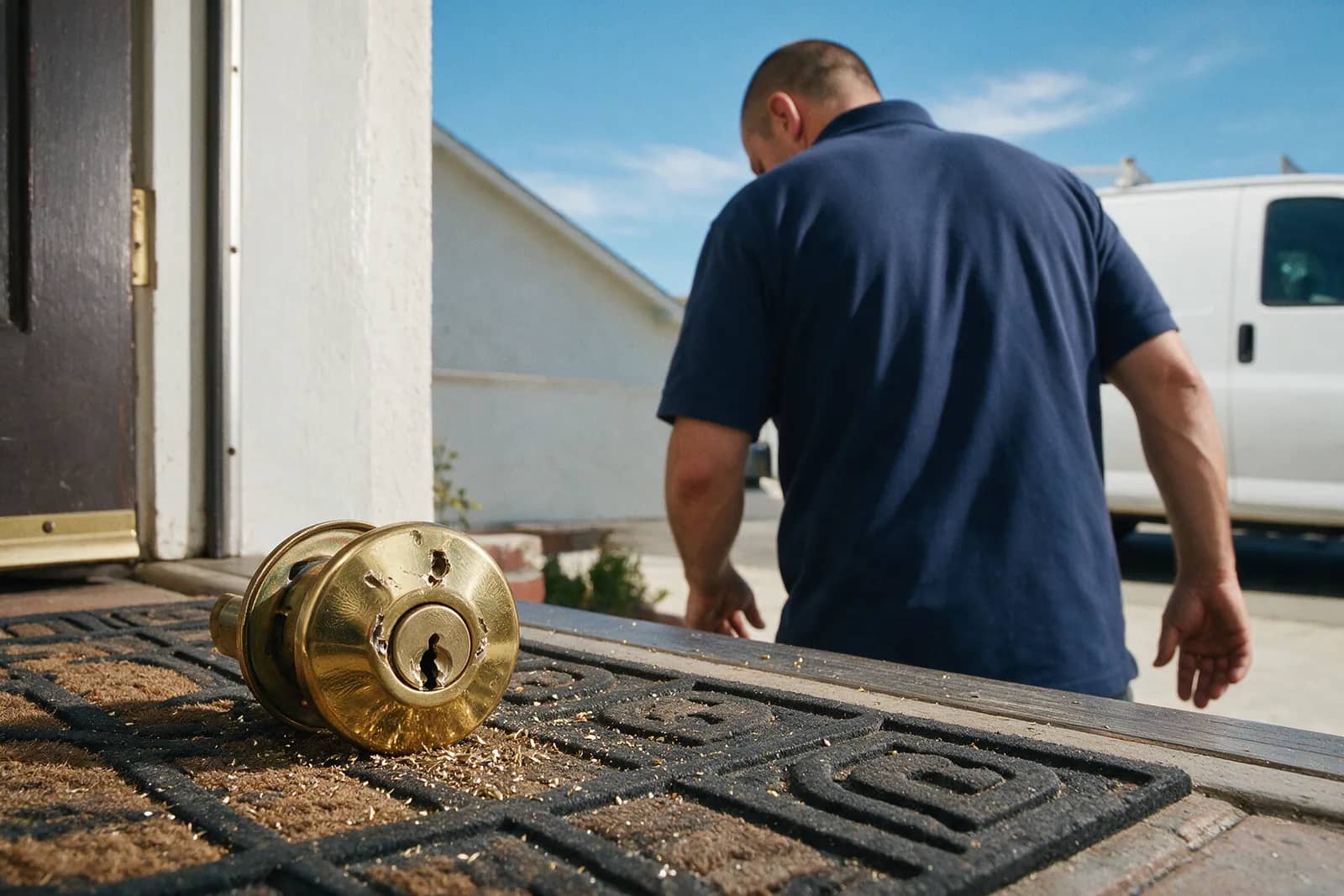
A spring latch holds a door closed. It does not hold a door locked against anything more than a turn of the knob. The latch is bevelled so it rides over the strike as the door closes, which means it can be pushed back by anything thin slid between door and jamb, and the small deadlatching plunger meant to prevent that is worn flat on most of these sets. The cylinder in the knob is also the most exposed part of the door: a knob can be twisted off with a wrench, taking the cylinder with it, and the latch retracts with a screwdriver in the hole that is left.
The jamb is the other half. In 1957 the strike was fixed with two three-quarter-inch screws into the jamb alone, and the jamb is a one-inch board nailed to the framing. That is what gives when a door is kicked. Any work on one of these doors includes a strike plate with three-inch screws that pass through the jamb and into the stud behind it, and that single change does more than any lock.
When repinning is worth doing
A rekey is $24 to $39 per cylinder and it is the right answer when the set is sound and the only problem is who has keys. After a purchase, after a tenant leaves, after a decade of gardeners and contractors, repinning the front, the kitchen door and the garage side door onto one key is an afternoon and leaves the house looking exactly as it did. The technician takes the plug out of the knob, replaces the pins to a new key, and puts it back.
It stops being worth doing when the plug is worn enough that a similar key already turns it, when the springs no longer return the pins, or when the keyway is one that no blank has been made for in decades. All three are common on original sets and all three are said plainly at the door. Then the choice is a new knob set on the same bore, or the same knob set kept for its looks with a deadbolt above it doing the actual work.
Adding a deadbolt without wrecking the slab
The exterior doors on these houses are solid, usually fir, and take a second bore well. The deadbolt goes about six inches above the knob, at the same 2 3/8 inch backset so the two line up, with a 2 1/8 inch bore through the face and a one-inch bore in the edge for the bolt. A template does the layout. A single-cylinder deadbolt, key outside and thumbturn inside, is the correct choice on any door that people leave through; a double-cylinder bolt needing a key from inside is a fire hazard on a bedroom-hallway door and is not fitted there.
The bolt and the knob can share a key if the keyways match, which usually means choosing the deadbolt to suit the knob rather than the other way round, or rekeying both to one key in the same visit. Lock replacement runs $109 to $299 per door and a deadbolt added above an existing knob sits toward the low end of that. The strike gets its three-inch screws, and the door is checked for swelling, since a bolt that binds in February is a door that needs an eighth of an inch planed rather than a lock that needs replacing.
The kitchen door, the garage and the side gate
The front door on a ranch house has usually had at least one upgrade. The kitchen door onto the yard has not, and the garage side door has a cam lock or a hasp, and the side gate has a bolt from inside and nothing outside. Those three are where the lockouts and the forced entries both happen, and they are what a visit on one of these houses is really about. A whole-property rekey covers all of them at $24 to $39 per cylinder; a gate gets a keyed latch so that the person taking the bins out can get back in.
The garage is worth a sentence of its own. On these lots it is detached and at the back, holds the bikes and the tools, and the side door was fitted with a passage knob and a hasp. A proper cylinder on that door, keyed to the house, is a replacement at $109 to $299, and it ends the padlock arrangement that has been there since the Eisenhower administration.
A smart lock on a 1957 door
Families in these houses ask about a smart lock for the same reasons everyone does: a code for the sitter, a code for the grandparent, and no key under the pot. Smart lock installation is $169 to $439 and the door has to be prepared for it. Most smart deadbolts want a 2 1/8 inch bore and a door between 1 3/8 and 1 3/4 inches thick, which these doors are, but an existing deadbolt bore from the 1980s may be the older 1 1/2 inch size and need opening out. The door must also close without being lifted or pushed, because a motor that cannot throw the bolt will report a locked door that is not.
Put the smart lock on the door the family actually uses, which on a ranch house is often the kitchen door or the garage door rather than the front, and leave the rest mechanical, rekeyed to one key. Wafer Lock & Key agrees the figure on the call, covering the visit, the labour and the parts, sends the technician's name and a thirty-minute window by text, and takes card or tap at the door with an itemized receipt by email. Arrival to the flats between Kiely Blvd and Lawrence Expressway runs nineteen to twenty-one minutes.
Quick answers
Is the original knob lock on my ranch house safe to keep?+
As a latch, yes. As the only lock on an exterior door, no. The usual answer is to keep the knob, add a single-cylinder deadbolt above it at $109 to $299, and fit a strike with three-inch screws into the framing. The knob can be rekeyed to match at $24 to $39.
Can a 1950s knob set be rekeyed?+
Usually, at $24 to $39 per cylinder, if the plug is not worn past the point where a similar key already turns it. The technician says which sets are worth repinning and which should be replaced on the same bore.
Will a smart lock fit a 1957 door?+
Most will. The door thickness is right and the standard bore is 2 1/8 inches; an older 1 1/2 inch deadbolt bore needs opening out. The door must close without being lifted, and the install at $169 to $439 includes checking that.
Need it handled rather than read about?
(669) 721-9707More guides